
05 · One possible future · feasibility study
Education.
The Campus.
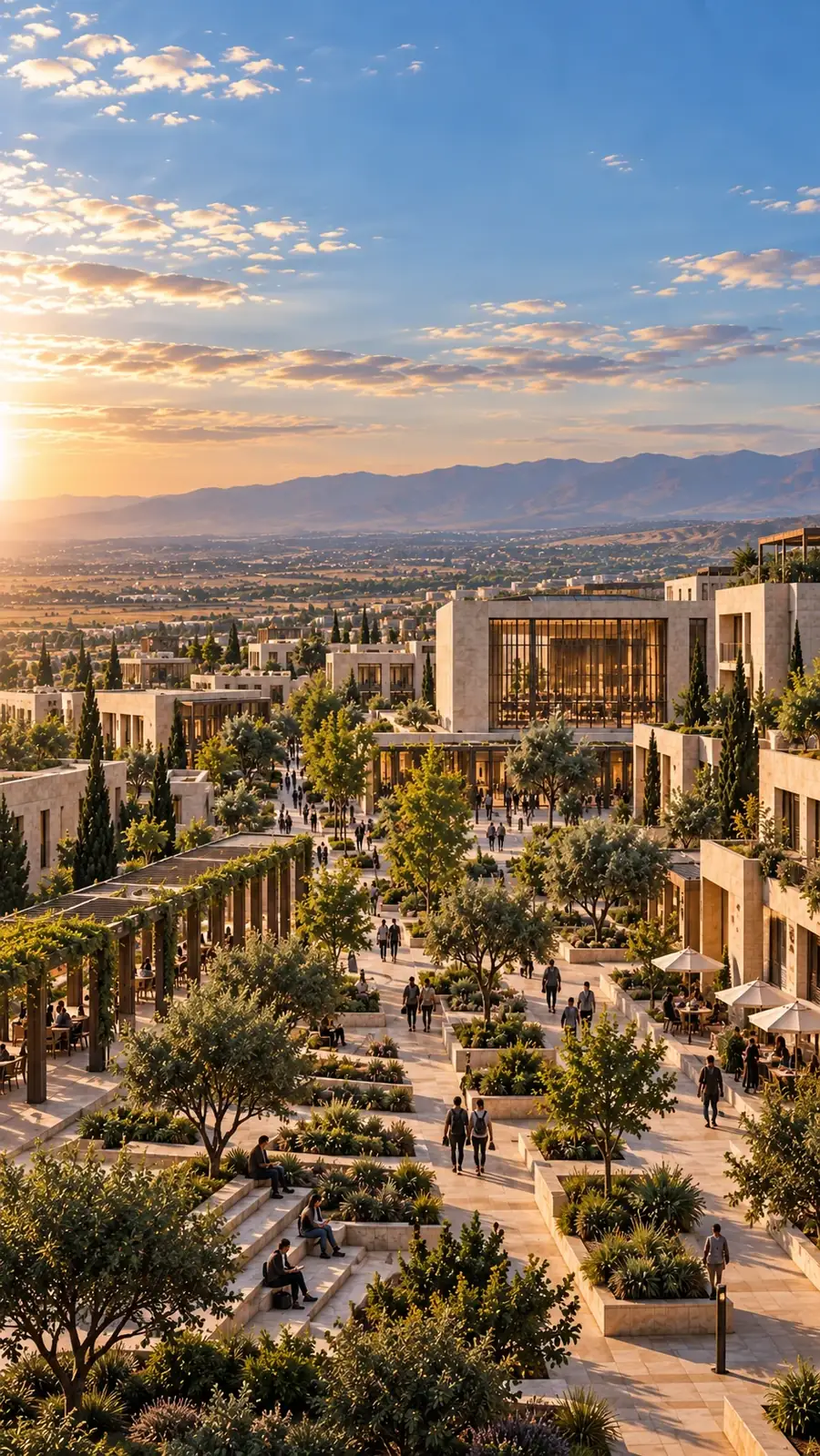
A campus for 5,000 students organised around a shaded spine — faculties, a library at the heart, student housing at the quiet end, playing fields at the edge — for a country rebuilding its institutions, studied to feasibility level.
THE IDEA
A campus for a country
rebuilding its institutions.
A country rebuilding its institutions needs campuses, and a campus needs land — ten hectares, in one title, reachable from every part of the capital. The Campus study organises a private university, or an international school group, around a central spine of shade: four faculty buildings on either side, a library at the heart, an auditorium and student centre at the arrival, playing fields at the eastern edge, and 700 student beds at the quiet northern end.
The corridor location matters for an institution with international faculty and regional students: the airport is ten kilometres away, the city seven, Jaramana’s young population next door. Low-rise, three and four storeys, the campus can be built faculty by faculty as enrolment grows.
Education is operator-led and long-term. The study is written for private university groups, international school operators, foundations and the development-finance institutions that fund education in reconstruction markets — and it proposes a ground lease as the route that fits them.
WHY NOW
A generation
coming home to learn.
More than 3.3 million refugees and internally displaced Syrians have returned since December 2024, and 3.9 million registered refugees remain in the region — a population with one of the youngest age profiles in the world, much of it of school and university age, much of it educated abroad in systems it will now expect at home. Families name schools among the conditions of return.
The capital’s universities are overstretched and its private and international schools are few and small. Diaspora families returning from the Gulf, Türkiye and Europe want international curricula; regional students from Iraq and Jordan want an Arabic-speaking capital with an international-standard campus. Sanctions relief has reopened academic partnerships and finance; a branch campus of an international university, unthinkable two years ago, is now a conversation.
WHY THIS PARCEL
Five reasons
an institution would choose it.
- Room for a real campus. Ten hectares: faculties, a library, housing and playing fields — and thirty years of growth on the same title.
- Reachable from the whole capital. Seven kilometres from the centre on the airport highway; bus routes from Jaramana and the south-east; ten minutes from the airport for visiting faculty and regional students.
- Quiet and air. Open land, low-rise buildings, shade — a place to study that no city plot can offer.
- Housing on site. 700 beds at the northern end; the regional and diaspora students an international institution attracts need somewhere to live.
- One title, long tenure. Institutions plan in decades; a single registered property held by one owner gives the certainty a fifty-year lease requires.
THE PROGRAMME
What the land
would hold.
| Component | Indicative scale | Note |
|---|---|---|
| Faculty buildings A–D — teaching, labs, offices | 45,000 m² GFA · 3–4 storeys | 5,000 students at maturity; built faculty by faculty |
| Library and learning commons | Included · at the heart of the spine | Reading rooms, digital, study courts |
| Student housing | 700 beds · 20,000 m² GFA | Three blocks at the quiet northern end |
| Auditorium, student centre, sports hall | 10,000 m² GFA | At the arrival; shared with the community |
| Playing fields, courts, gardens | ≈ 30,000 m² | Eastern edge; a pitch and courts |
| Parking | ≈ 700 bays | At grade, south, with a bus interchange |
| Gross floor area above ground | ≈ 75,000 m² GFA | Plot ratio ≈ 0.75 · 3–4 storeys — to be tested against zoning and Ministry licensing |
Indicative programme for discussion. Enrolment, faculty mix and heights must be tested against Ministry of Higher Education or Ministry of Education licensing and current zoning before any figure is relied on. The same masterplan serves a K-12 international school group at ≈ 3,000 pupils.

INDICATIVE MASTERPLAN
Four faculties,
one spine.
The parcel outline is the source-derived presentation diagram of the supplied survey; the blocks are indicative and drawn for discussion. Phase 1: faculties A–B, library, auditorium, spine, utilities. Phase 2: faculties C–D, fields. Phase 3: housing.
THE NUMBERS
What it costs
to build.
| Cost item | Basis | US$ |
|---|---|---|
| Faculty buildings and library, 45,000 m² GFA | US$800 / m² — teaching, laboratories, fitted | 36,000,000 |
| Student housing, 20,000 m² GFA | US$550 / m² — 700 beds | 11,000,000 |
| Auditorium, student centre, sports hall, 10,000 m² GFA | US$900 / m² — long-span, fitted | 9,000,000 |
| Playing fields, courts, gardens, spine | US$70 / m² over ≈ 30,000 m² | 2,100,000 |
| Parking and bus interchange | 700 bays at grade | 1,050,000 |
| Utilities | Substation and grid connection, water and storage, sewage treatment and reuse, telecoms | 4,000,000 |
| Professional fees and permits | 8% of hard cost | 5,050,000 |
| Contingency | 10% of hard cost | 6,320,000 |
| Development cost, excluding land | ≈ US$994 per m² GFA | 74,520,000 |
Unit rates are 2026 benchmarks for educational construction in Jordan and the Levant with an allowance for import conditions in Syria. Excludes laboratory and IT equipment, furniture, finance costs, taxes and VAT. All figures are indicative and pre-design.
THE RETURN
Three ways
this can be done.
A campus is an institution, not a rental asset; its economics belong to the operator. The study assumes 5,000 students at maturity paying an average of US$3,500 a year, 700 beds at US$2,500, ancillary income of 5%, and an EBITDA margin of 25% — in the range of private universities in Jordan and Lebanon — and tests enrolment from 4,000 at US$3,000 to 6,000 at US$4,000. Revenue at base: ≈ US$20M a year; EBITDA ≈ US$5.0M.
Institution acquires and builds.
A university group, foundation or endowment buys the land at the asking price and builds its own campus, faculty by faculty. It owns a freehold campus at about US$20,000 per student place — a fraction of Gulf branch-campus costs.
Long ground lease.
PETRA retains the land and leases it for 30–50 years to the institution that builds and operates. Indexed ground rent set as a share of tuition revenue rather than a fixed sum, so it grows with the campus; the institution’s capital goes into faculties, not land; PETRA holds an indexed income and the reversion.
Branch campus partnership.
An international university opens a Damascus branch with a local investor and a development-finance institution: the investor builds, the university operates and lends its name, PETRA contributes the land as equity or lease. The model Gulf education cities used; the one lenders already know.
| Enrolment · average tuition | Annual revenue | EBITDA (25%) | EBITDA on all-in cost (US$99.5M) | Ground rent at 6% of revenue (Route B) |
|---|---|---|---|---|
| 4,000 · US$3,000 | US$14M | US$3.6M | 3.6% | US$0.9M |
| 5,000 · US$3,500 · base | US$20M | US$5.0M | 5.1% | US$1.2M |
| 6,000 · US$4,000 | US$27M | US$6.7M | 6.8% | US$1.6M |
Operator economics at maturity (year 5–6), unlevered, before finance and tax. Universities are 50-year institutions whose value is reputation and enrolment, not yield; concessional development finance and endowment capital materially change the picture. There is no Damascus benchmark; the sensitivity is the point of the table.
WHAT THE INSTITUTION GETS
The case
for a university.
- The first international-standard campus in the capital — the reference institution for a country of 24 million rebuilding its universities.
- Land that costs faculties nothing. Under the ground-lease route the institution’s capital goes entirely into buildings and people.
- Growth in place. Faculty by faculty for thirty years inside the same title; housing for the students an international name attracts.
- Reach. Seven kilometres from the centre, ten from the airport, a young population next door.
- Finance that fits. Development-finance institutions and education funds back campuses in reconstruction markets; the branch-campus route is the one they already know.

RISKS AND MITIGANTS
What could
go wrong.
| Risk | Mitigant |
|---|---|
| Ministry of Higher Education / Education licensing for a private institution | Engage the Ministry first; align programmes with national priorities; the branch-campus route brings an accredited partner. |
| Enrolment and tuition levels are untested | Phase faculty by faculty; open with high-demand programmes (engineering, medicine-adjacent, business, IT); diaspora and regional intake; wide sensitivity in this study. |
| Faculty recruitment | International partner; diaspora academics returning; on-site housing for visiting faculty. |
| Transport for students without cars | Bus interchange at the gate; routes to Jaramana and the south-east; student housing on site. |
| Power and water reliability | Rooftop PV on every building, battery back-up, water storage and reuse — priced in. |
| Construction cost inflation | 10% contingency; phased build; fixed-price packages; laboratory equipment procured separately. |
| Political and compliance risk | Counterparty screening; DFI participation; international arbitration; political-risk insurance. |
SOURCES
Where the figures
come from.
- UNHCR Syria Operational Update, March 2026 — over 1.5M refugees and 1.8M IDPs returned since Dec 2024; education among the services that condition return. ↗
- IOM / 3RP 2026 — 3.9M registered Syrian refugees in the region as of Dec 2025, a large share of school and university age. ↗
- World Bank, Oct 2025 — Syria reconstruction estimate US$216BN; education facilities among damaged public infrastructure. ↗
- Arab News, 12 May 2026 — first Syrian-UAE Investment Forum; services and human capital among target sectors. ↗
- The National, 26 Aug 2026 — international card payments returning; diaspora re-engagement. ↗
- U.S. Department of State — comprehensive sanctions revoked June 2025; Caesar Act repealed December 2025 (international academic partnerships and finance). ↗
Cost and operating figures are PETRA study assumptions built from regional benchmarks; they are not quotations or a valuation. Nothing on this page is an offer or investment advice. Independent legal, planning, academic, technical and financial review is required.
FOR UNIVERSITIES, SCHOOL GROUPS, FOUNDATIONS AND DFIs
Read the full
feasibility study.
Thirteen pages: the asset, the corridor, the market, the programme, the masterplan, the development budget, operator economics, three deal routes including a ground lease, risks, and the diligence sequence.