
07 · One possible future · new study
Logistics
Hub.
The Hub.
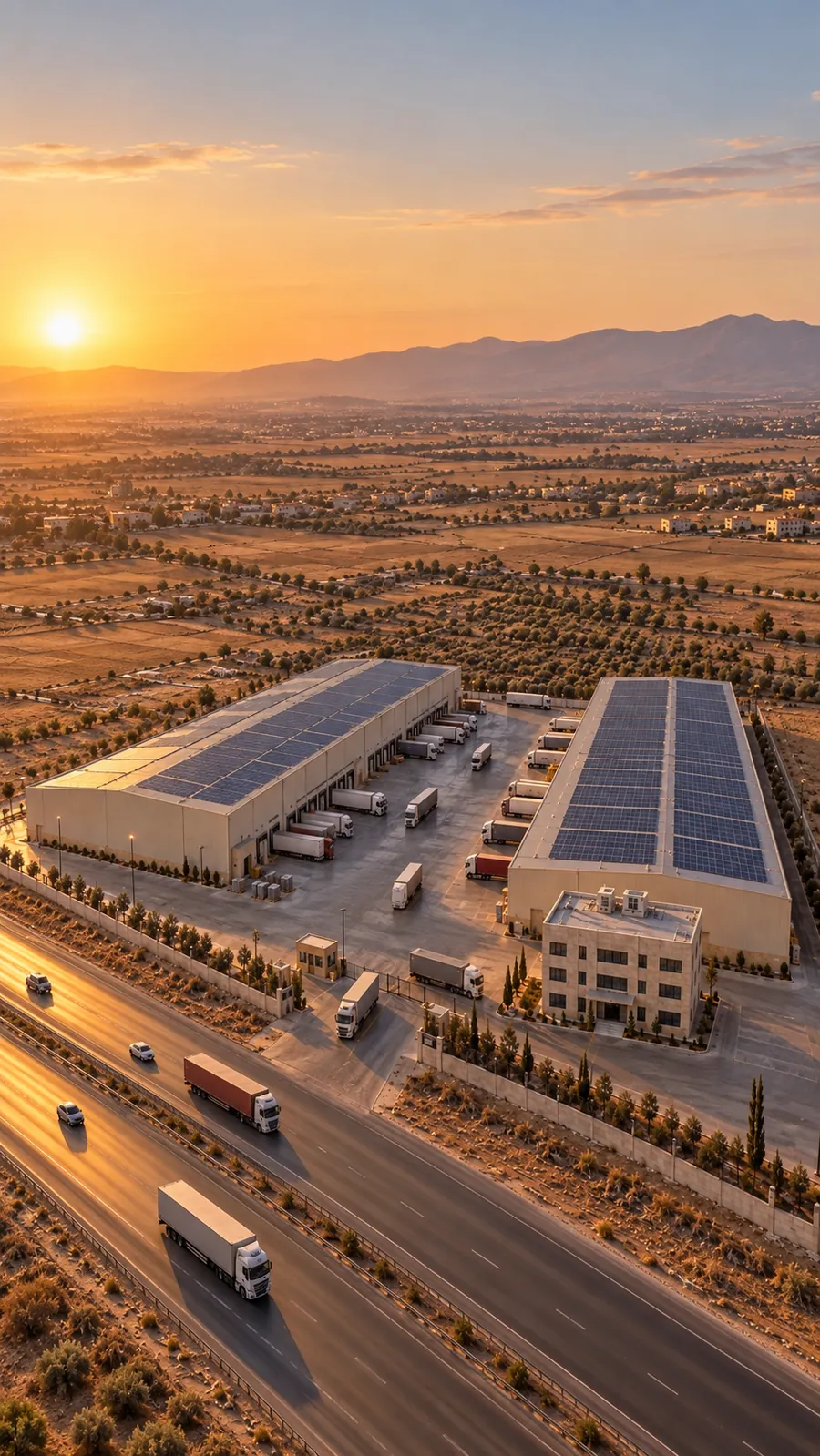
A Grade A fulfilment and distribution hub on the road that links the capital to its airport. Conceived for a national e-commerce operator, a global 3PL or a bonded regional distributor — and studied to feasibility level.
THE IDEA
Serve the capital
from the corridor.
Every national e-commerce operation begins with one building: a fulfilment centre close enough to the largest city to deliver the same day, close enough to the airport to receive air freight, and on the road that trucks from the ports and the borders already use. On the Damascus corridor that building does not yet exist.
The Hub study proposes it on Property No. 14: a Grade A cross-dock logistics and fulfilment facility of roughly 46,500 m² in two phases, with a 44-metre truck yard, a three-storey office block, rooftop solar for energy independence and a design that can be certified as a bonded warehouse. It is sized to the same order as the regional benchmark — Amazon’s Riyadh fulfilment centre is about 36,000 m² over five floors — but built single-storey on ten hectares, which is cheaper to construct, faster to operate and easier to expand.
The study is written for three kinds of counterparty: a national e-commerce platform entering Syria (Amazon, noon, Talabat-type operators), a global third-party logistics company (DHL, Aramex, DP World Logistics, Agility), and a bonded regional distributor serving Syria, Lebanon, Jordan and Iraq from one point. The full feasibility study is available below.
WHY NOW
The market
has moved.
Three things changed in the last eighteen months. Comprehensive U.S. sanctions were revoked in June 2025 and the Caesar Act repealed in December 2025. Gulf port operators moved into Syrian ports — DP World at Tartous, AD Ports at Latakia — and Syrian and Emirati officials are now discussing a logistics corridor from those ports through Iraq to the Gulf. And Damascus itself began to trade online again: international card payments returned in 2026, the first Syrian E-Commerce Forum was held in August, and the government has named e-commerce a strategic priority.
What has not changed is the supply of space to serve that demand. Syria’s General Establishment for Free Zones reports that the Damascus Free Zone is at 100% occupancy, that around 90% of ready-built facilities across all zones are taken, and that demand in 2026 has exceeded expectations. There is no Grade A fulfilment centre on the Damascus airport corridor. The first operator to build one will define the market.
WHY THIS PARCEL
Five reasons
an operator would choose it.
- Distance. 7 km to central Damascus: same-day and next-hour delivery to the densest market in the country. 10 km to the airport for inbound air freight. 1.2 km to Jaramana and 4 km to Sayyida Zainab — the population is next door.
- The road. Highway frontage on the Damascus International Airport highway, the corridor that trucks from Tartous and Latakia, from the Jordanian border at Nassib and from the Lebanese border already use to reach the capital.
- One title. 103,066 m² held in full by one owner. Assembled land at this scale on the corridor is rare; a single signature removes months of assembly risk.
- Flat, regular, buildable. A near-rectangular main body of about 231 m by 410–428 m — the proportions a cross-dock warehouse wants — with room for a full-depth yard on both faces.
- Nothing to demolish, nothing to relocate. The land is open. Site works can begin as soon as permits allow.
THE SPECIFICATION
Built to
international standard.
| Element | Specification | Why it matters |
|---|---|---|
| Warehouse | 42,000 m² in two phases (24,000 + 18,000), steel portal frame | Phase 1 operational while Phase 2 is built |
| Clear height | 12.5 m to underside of haunch | Four-level racking or mezzanine automation |
| Floor | FM2 flatness, 50 kN/m² UDL | Automated picking and heavy racking |
| Docks | 26 dock-levellers in Phase 1, 20 in Phase 2; 4 level-access doors | Cross-dock and van-loading |
| Yard | 44 m truck yard between halls; 35 m aprons; 120-car park; van marshalling | Peak-day throughput without queuing on the highway |
| Fire | ESFR sprinklers, 2 × 600 m³ tanks, diesel pumps | Insurer and tenant requirement |
| Office | 4,500 m² over three storeys, Cat A fit-out | Operations, customer service, training |
| Energy | Rooftop PV ~4.8 MWp with 2 MWh storage (option); N+1 generators | Operating independence from an unreliable grid |
| Customs | Layout and perimeter designed for bonded status | Duty-suspended regional distribution |
| Security | Perimeter fence, gatehouse, CCTV, 24/7 control room | Operator standard |
Specification reflects a Grade A logistics standard as built in the Gulf and Jordan. Final design would be tenant-led under a build-to-suit agreement.

INDICATIVE MASTERPLAN
Two halls,
one yard.
The parcel outline is the source-derived presentation diagram of the supplied survey. The blocks are indicative and drawn for discussion. Site coverage ≈ 41%.
THE NUMBERS
What it costs
to build.
| Cost item | Basis | US$ |
|---|---|---|
| Warehouse shell & core, 42,000 m² | US$580 / m² — frame, roof, FM2 floor, docks, ESFR, LED | 24,360,000 |
| Office block, 4,500 m² | US$900 / m² — Cat A | 4,050,000 |
| Yard, roads, parking, fencing, gatehouse | US$95 / m² over ~52,000 m² external | 4,940,000 |
| Utilities | Substation and grid connection, water, wastewater, fire water, telecoms | 3,200,000 |
| Professional fees and permits | 8% of hard cost | 2,920,000 |
| Contingency | 10% of hard cost | 3,650,000 |
| Development cost, excluding land | ≈ US$928 per m² of lettable area | 43,130,000 |
Rooftop solar (≈ US$3.5M for 4.8 MWp with storage) is priced separately as an operator option; at a grid-and-diesel cost of US$0.12 / kWh it would return about US$0.95M a year. Costs are regional benchmarks (Jordan, Egypt, Gulf) with an allowance for import conditions in Syria, at 2026 prices. All figures are indicative and pre-design.
THE RETURN
Three ways
this can be done.
Grade A logistics rents in the region run from about US$60–90 per m² a year in Amman and Cairo to US$120–160 in Dubai. There is no Damascus benchmark, because there is no Damascus Grade A stock. The study uses US$110 per m² a year as the base case for a bonded-capable, energy-independent facility on a fully occupied corridor, and tests it from US$85 to US$140.
Operator acquires and builds.
An e-commerce platform or 3PL buys the land at the asking price and builds its own national hub. It owns a freehold, single-storey, expandable facility on the corridor for US$1,465 per m² all-in — against multi-storey Gulf fulfilment centres that cost more and are leased, not owned.
Land-for-equity partnership.
PETRA contributes Property No. 14 at the asking price as equity — about 37% of the all-in cost. A developer-operator funds construction (US$43.1M) and signs the anchor tenant. The project earns a cash yield on the money actually spent, and PETRA holds an income-producing asset instead of land.
Investor build-to-suit and lease.
A logistics investor buys the land, builds to the tenant’s specification and leases it on a 15-year triple-net term to a credit tenant. The route works at scarcity rents and with a long lease; it is the most exposed of the three to the rent assumption.
| Rent US$ / m² / yr | Net operating income | Yield on all-in cost US$68.1M | Yield on cash cost land as equity, US$43.1M | Value at 8% cap |
|---|---|---|---|---|
| 85 | US$3.79M | 5.6% | 8.8% | US$47M |
| 95 | US$4.24M | 6.2% | 9.8% | US$53M |
| 110 · base | US$4.91M | 7.2% | 11.4% | US$61M |
| 125 | US$5.58M | 8.2% | 12.9% | US$70M |
| 140 | US$6.25M | 9.2% | 14.5% | US$78M |
Net operating income assumes a triple-net lease with 4% non-recoverable costs. Yields are unlevered, on 46,500 m² fully let. The rent an operator will pay in Damascus is untested; the sensitivity is the point of the table, not the base case.
WHAT THE TENANT GETS
The case
for an operator.
- First-mover position on a corridor with no Grade A supply and a free-zone system that is full.
- A national hub and a regional one. Damascus is 115 km from Beirut, about 180 km from Amman and on the discussed corridor from Syrian ports through Iraq to the Gulf. A bonded facility here can serve four markets.
- Control of the timetable. Open land, one owner, no demolition: the critical path is permitting and construction, not assembly.
- Energy independence. A 42,000 m² roof carries a solar plant that covers daytime operations and removes exposure to the grid.
- Room to grow. Phase 2 is designed in from day one; the hall can double without a second site.
- A partner, not just a landlord. PETRA is prepared to structure land as equity, a long ground lease, or a build-to-suit — whichever fits the operator’s balance sheet.

RISKS AND MITIGANTS
What could
go wrong.
| Risk | Mitigant |
|---|---|
| Zoning does not currently permit logistics use | Confirm permitted use and any corridor master-plan designation before any commitment; apply for change of use if required, with the investment authority’s one-stop shop. |
| Rent assumption is untested in Damascus | Structure as build-to-suit with a signed anchor lease before construction; land-for-equity shares the risk rather than pricing it into rent. |
| Grid power and water reliability | Rooftop PV with storage, N+1 generation, on-site water storage and treatment; priced in the option. |
| Customs and bonded-status approvals | Engage the General Authority for Borders and Customs early; design to free-zone perimeter standards from the outset. |
| Construction cost inflation and import conditions | 10% contingency; steel-frame procurement from Turkey or the Gulf; phase the build. |
| Political and compliance risk; targeted sanctions remain | Counterparty screening; transaction-specific compliance advice; international arbitration in contracts. |
| Airport programme timing is outside PETRA’s control | The hub does not depend on the airport expansion: Damascus demand alone supports Phase 1. |
SOURCES
Where the figures
come from.
- U.S. Department of State — Syria Sanctions: Executive Order 14312 revoking comprehensive U.S. sanctions (30 June 2025); Caesar Act repealed (18 December 2025). ↗
- SANA, 29 Aug 2026 — General Establishment for Free Zones: demand exceeded expectations in 2026; six-step, 15-working-day allocation process. ↗
- Enab Baladi, Sept 2026 — 800 free-zone contracts signed; Damascus Free Zone at 100% occupancy; ~90% of ready-built facilities occupied. ↗
- SANA, 25 June 2026 — Syrian–UAE talks on a logistics corridor linking Syrian ports to the Gulf via Iraq; AD Ports Group. ↗
- Arab News, 12 May 2026 — DP World US$800M Tartous terminal MoU; AD Ports 20% of Latakia container terminal; UAE interest in Syrian free zones. ↗
- SANA, 3 Aug 2026 — Syrian E-Commerce Forum 2026, Damascus; Minister of Communications on e-commerce as a strategic priority. ↗
- The National, 26 Aug 2026 — international card payments return; visitor arrivals 3.52M in H1 2026. ↗
- AP / Syrian Investment Authority, 6 Aug 2025 — US$4BN Damascus International Airport programme, up to 31M passengers a year. ↗
- Gulf News, 2023 — Amazon Riyadh fulfilment centre: 390,000 sq ft over five floors, 9M items (regional benchmark). ↗
Cost and rent figures are PETRA study assumptions built from regional benchmarks; they are not quotations. Nothing on this page is an offer, a valuation or investment advice. Independent legal, planning, technical and financial review is required.
FOR OPERATORS AND LOGISTICS INVESTORS
Read the full
feasibility study.
Thirteen pages: the asset, the corridor, the market, the specification, the masterplan, the development budget, three deal routes with sensitivities, risks, and the diligence sequence. Prepared for presentation to e-commerce platforms, 3PLs and bonded distributors.